

84% (±10) Gas Savings in CEX Deposit Management — Scalable Custody via CREATE2 + ERC-1167
A Turkey-based crypto asset platform was facing high gas costs and operational complexity while moving user deposits from sub-addresses to centralized admin/treasury wallets. As Vinu Digital, we transitioned the system to a “deploy-on-first-deposit” architecture based on CREATE2 + Minimal Proxy; thanks to the new workflow—supported by batch sweeping, dynamic gas scheduling, and a nonce pool—we achieved an 84% (±10) reduction in total monthly gas consumption.
Code complexity decreased, UX improved, and security and auditability were strengthened.
Customer Profile
- Sector: Centralized cryptocurrency exchange
- Networks: Ethereum and EVM-compatible chains
- Volume Dynamics: ~50 daily deposits; support for multiple ERC-20 tokens
- Priorities: Cost, security, regulatory compliance, developer experience
The Problem
The traditional model required two on-chain transactions for every deposit:
- Admin → User wallet (small amount of ETH for gas)
- User wallet → Admin wallet (token transfer)
This amounted to ~3,000 transactions and ~270,000,000 gas per month.
Additional challenges:
- Cost volatility due to gas spikes
- Nonce conflicts and transactions stuck in the mempool
- Diversity of token standards (ERC-20/721/1155)
- Reorg resilience and reconciliation errors
- Hot wallet security and key management risks
Objectives
- 80%+ gas savings
- Simplified code and operations
- Robust security posture (multisig/HSM, RBAC)
- Automation (retry/reorg, scheduling, monitoring)
- Future-proofing (ERC-4337/6900/7579, L2 strategies)
Solution Architecture
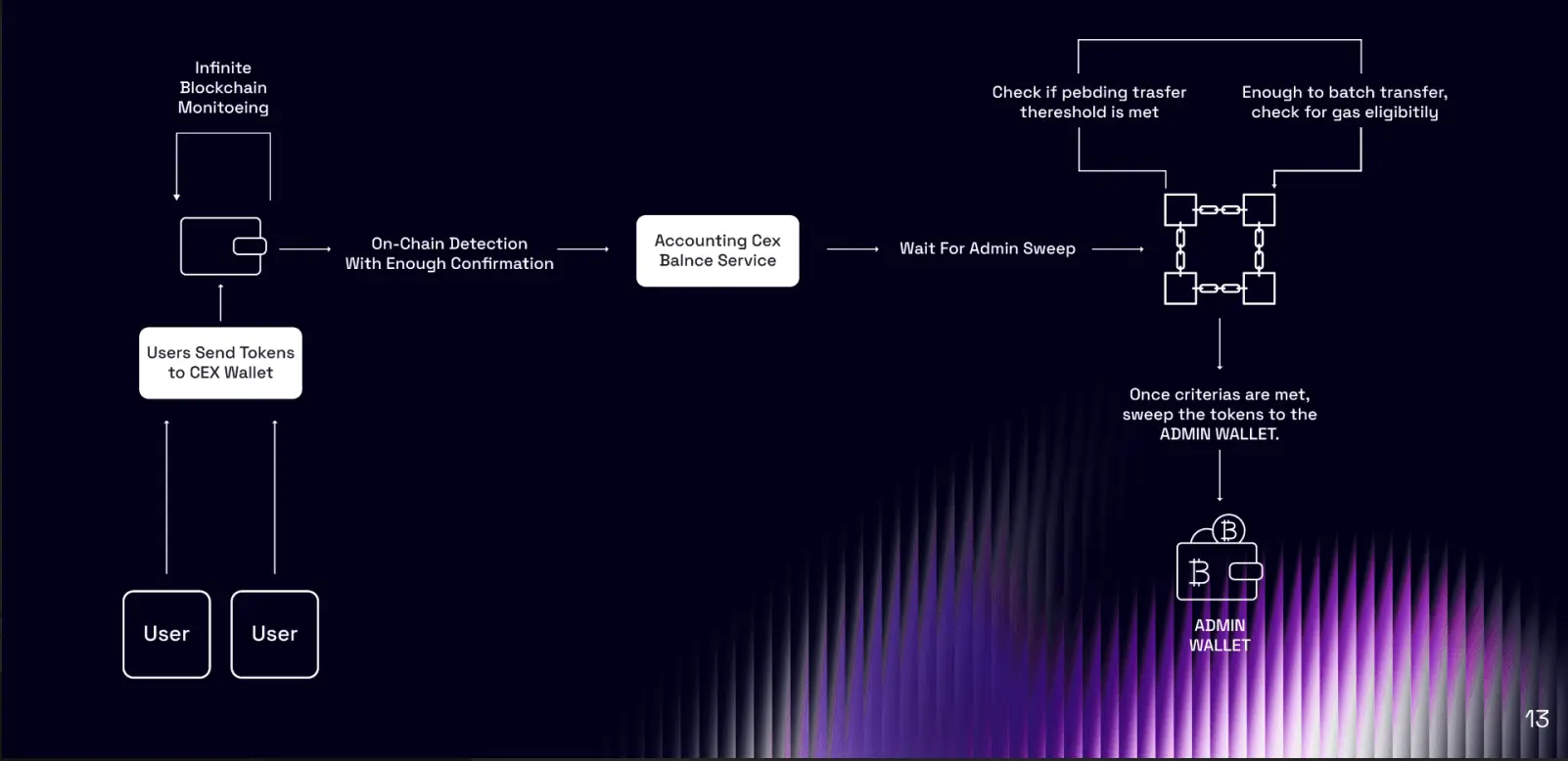
1) CREATE2 + ERC-1167 (Minimal Proxy) — Selected Approach
- Deterministic addressing:
computeAddress(userId, chainId, version) - Deployment on first deposit: Wallet contract deployed upon detection of the first token inflow
- Low-cost clones: All user wallets are clones linked to a single Implementation
- Batch sweep: Tokens from multiple users collected in a single transaction
2) Sweep & Transaction Optimization
- Dynamic gas scheduling (EIP-1559) & gas windowing
- Nonce Pool Manager (preventing conflicts in parallel transactions)
- Batching during off-peak hours (automated trigger)
3) Monitoring, Alerting, and Resilience
- Prometheus + Grafana metrics, Slack/Discord/PagerDuty alerts
- Event Watcher
- Retry & Reorg: Idempotent queues, automatic acceleration/cancellation
4) Security & Compliance
- Multisig/HSM signing
- RBAC + SSO, JWT-based API access
- OpenZeppelin security patterns
- Audit trail
5) Management Panel
- Blockchains / Currencies / History / Balance / Chain Analysis / Listeners / Scheduler
- Live listeners, filtering, manual/automatic sweep triggering, detailed transaction slips
Implementation Plan
- Week 1–2: Discovery, metric analysis, risk & requirements
- Week 3–4: Factory & Proxy contracts, testing (Foundry/Hardhat, mainnet-fork)
- Week 5: Event watcher, batch/scheduler, nonce pool
- Week 6: Prometheus/Grafana dashboards, Slack/PagerDuty integration
- Week 7: Security hardening (RBAC/SSO, HSM/Multisig workflows)
- Week 8: Phased live rollout and monitoring
Measurable Impact
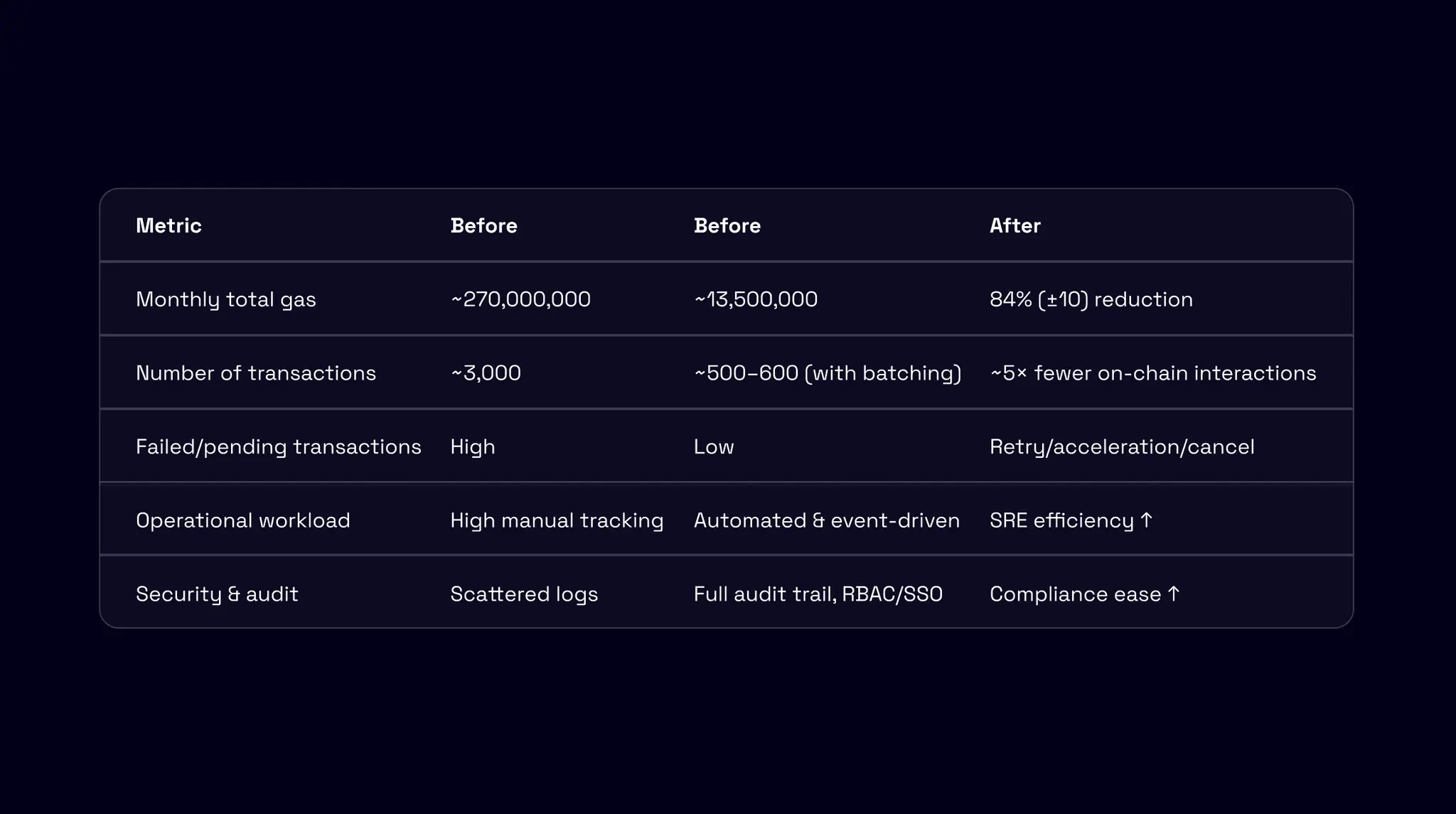
Additional benefits:
- User experience: Eliminated the need for users to hold ETH or perform approvals.
- Code simplification: Unified flow based on heterogeneous token logic.
- Scalability: Unlimited deterministic address management.
Challenges & Solutions
- Gas spikes: Gas oracle + scheduled batching with “windowing”
- Nonce conflicts: Centralized Nonce Pool and mutexes
- Reorg risk: Idempotent queues and confirmation threshold policies
- Token variations: Abstract “sweep” interface at the contract level
- Operational visibility: Grafana dashboards, real-time alert channels
Technologies Used
- On-chain: Solidity, CREATE2, ERC-1167, OpenZeppelin, EIP-1559
- Monitoring: Prometheus, Grafana, Slack/Discord/PagerDuty
- Orchestration: Kubernetes CronJobs / container workers
- Integration: REST & WebSocket API, Webhook, JWT, RBAC, SSO
- Security: Multisig/HSM, TLS, KMS, MFA, least-privilege
- Data/Reconciliation: PostgreSQL/OLAP, detailed audit logs
Client Testimonial
“The new architecture didn’t just lower costs; our operational visibility and response speed improved significantly. The maintenance burden on our teams was dramatically reduced.”
Why Vinu Digital?
Vinu Digital handles custody management—one of the most critical operations for crypto platforms—by... ...makes it cheaper, more secure, and far more scalable.
Our proven CREATE2 + ERC-1167 architecture, combined with best-in-class transaction efficiency, delivers immediate, measurable gains to our customers.
With our productized management dashboard, platform teams benefit from full visibility, the power of automation, and reduced operational overhead. Risks are minimized—and growth barriers eliminated—through regulation-friendly, detailed audit trails and enterprise-grade security controls.
In short:
- Custody that creates value, not just costs
- Architecture built for the future, not just today
- Robust security, limitless scalability
Vinu Digital — Transforms your Web3 infrastructure into a genuine competitive advantage.