






BLOG DETAIL
How Does the X-to-Earn Ecosystem Work? Technology, Tokenization, and User Loyalty
October 10, 2025 10:13 AM
KEY:#x-to-earn#tokenization#blockchain rewards#user loyalty#gamification#web3 economy#crypto incentives
Think like a foundation app: you should increase your popularity among the public by encouraging daily engagement and building user loyalty. For example, increasing click-through rates or daily app visits helps users become familiar and invested in the platform. Offering small, frequent rewards for logging in regularly can motivate users to return every day. Features like leaderboards, streaks, or challenges can make interaction fun and habit-forming.
Additionally, transparent tracking of rewards and easy access to earned tokens or points strengthens trust and encourages users to stay active over time. What about your app is on the blockchain ecosystem? How can we make this happen? At this point, X-to-Earn mechanisms fully meet our needs. Especially blockchain technology is a great environment to ensure this. We will explain this to you in this paper.
The Role of Blockchain in X-to-Earn Models
The X-to-Earn ecosystem refers to a model, particularly in the crypto and blockchain world, where users earn rewards by performing a specific action on a platform. Here, “X” represents the action the model focuses on. Among the most popular examples of this are:
- Play-to-Earn (P2E): Earning by playing.
- Move-to-Earn (M2E): Gaining through physical activity such as walking or running.
- Learn-to-Earn (L2E): Earning by completing training or tests.
- Create-to-Earn (C2E): Earning money by creating content.
- Social-to-Earn (S2E): Earning through social media or community participation.
- Watch-to-Earn (W2E): Earning by watching videos or advertisements.
- Read-to-Earn (R2E): Earning by reading articles, books, or educational materials.
When the term “earn” comes into play, this is the point we should highlight. As explained at the beginning of this paper, blockchain technology provides the most suitable infrastructure to encourage and reward user participation. In this model, every action performed by the user—whether it’s walking, learning, or creating content—is recorded, verified, and rewarded through blockchain-based smart contracts. This system ensures transparency, automates reward distribution, and strengthens user engagement within decentralized platforms.
To illustrate this mechanism more concretely, let’s consider an example from the Move-to-Earn model. In an application developed by a blockchain company, users can earn tokens worth 1 dollar for every 10 steps they take. This reward system aims to encourage daily physical activity by tracking movements through the app. While the tokens are securely recorded on the blockchain, user rewards are automatically distributed via smart contracts. This way, physical activity and digital asset generation come together to enhance both user loyalty and platform interaction.
But how does the system actually know how many steps we take? Here is where the Internet of Things (IoT) comes into play.
What is IoT?
IoT is the collection and sharing of data by physical objects connected to each other via the internet, and sometimes making decisions among themselves. In other words, not only computers or phones, but now many objects such as cars, refrigerators, watches, and sensor-equipped shoes are becoming “smart.”
Sensors in smartwatches or smartphones collect users' step counts and movement data and securely transmit this information to a blockchain infrastructure via the internet. Smart contracts running on the blockchain automatically verify this data and instantly distribute rewards to users. Thus, physical activity is rewarded with digital assets, while user loyalty and app engagement also increase.
This example demonstrates how the convergence of IoT and Web3 technologies offers innovative solutions for both data collection and secure token distribution.
The Role of Oracles: Bridging IoT and Blockchain
IoT devices generate data such as the number of steps taken, movements, or collection data; however, it is not possible to send this data directly to the blockchain. This is where the oracle mechanism comes into play. Oracles collect this data from the outside world, verify it, and securely transmit it to smart contracts. This allows the blockchain to be aware of events occurring outside of itself.
For example, an oracle verifies whether a user has taken 10,000 steps, and the reward contract is executed based on this information. This enables X-to-Earn systems to become not just “data collectors,” but also “data-driven, reliable reward distribution networks.”
Beyond Foundation Benefits
X-to-Earn systems are not limited to a one-sided relationship; they are useful in areas such as increasing the visibility of foundations, improving user experience, and increasing the usage rates of applications.
One of the most well-known of these mechanisms is StepN, a sports and health-focused version of Play-to-Earn. The app was launched at the end of 2021 and gained significant popularity in 2022. Users earn tokens by walking, running, or training, with activity tracked through IoT sensors and GPS data. Tokens can be traded, reinvested in new digital assets, or staked to generate passive income. The model not only encourages healthier lifestyles but also increases interaction within the broader crypto ecosystem.
Why It Matters for Projects
X-to-Earn models create a cycle that grows not only users but also the projects themselves. Users are motivated to earn rewards, so they use the platform more frequently, which directly increases the number of active users and engagement. As engagement increases, the community grows organically, a loyal user base forms around the project, and the foundation's brand value rises.
This growth is not limited to visibility: it generates chain-reaction economic effects such as revenue generation through the token economy, increased liquidity through staking mechanisms, and strengthened investor interest. In short, X-to-Earn systems are a strategy that supports not only users but also the sustainable growth of projects.
Therefore, X-to-Earn software for customers stands out as a scalable investment area that both increases user engagement and directly contributes to the project economy.
Broader Impact: Social and Environmental Applications
X-to-Earn mechanisms do more than just improve user experience or increase the visibility of foundations; when designed correctly, they can also deliver social and environmental benefits. For example, in some waste collection projects in Kenya and Tanzania, individuals earn token rewards by recording the plastics they collect in blockchain-based systems.
This system works similarly to Move-to-Earn or Play-to-Earn applications, where step counts are converted into tokens: users receive economic rewards for their daily contributions while also contributing to environmental cleanliness. Blockchain and smart contract technologies securely and transparently record collection data, enabling the automatic distribution of rewards.
Thus, X-to-Earn mechanisms can create social and environmental impact, not just limited to digital asset acquisition or foundation benefits.
The Aquapurge initiative in Kenya and the Chatafisha initiative in Tanzania are projects where participants earn crypto rewards in exchange for the waste they collect, contributing to environmental cleanup while also enabling local communities to generate income. Under Aquapurge, more than 5,400 kilograms of waste were collected during events held at Diani Beach, and sustainable funding was secured through Verifiable Impact Reports. Chatafisha aims to prevent pollution in rivers and lakes in Dar es Salaam, thus providing both environmental benefits and community support.
These examples demonstrate that X-to-Earn mechanisms form a powerful model for environmental cleanup and social benefit; participants earn income while contributing to sustainable development and community welfare.
Tokenization vs. Traditional Advertising
When it comes to user loyalty and recognition, advertising usually comes to mind. From newspapers to social media, many brands and foundations have established themselves and promoted themselves in the public eye through advertising.
So why would shifting from the traditional advertising approach to implementing the X-to-Earn mechanism yield more effective results?
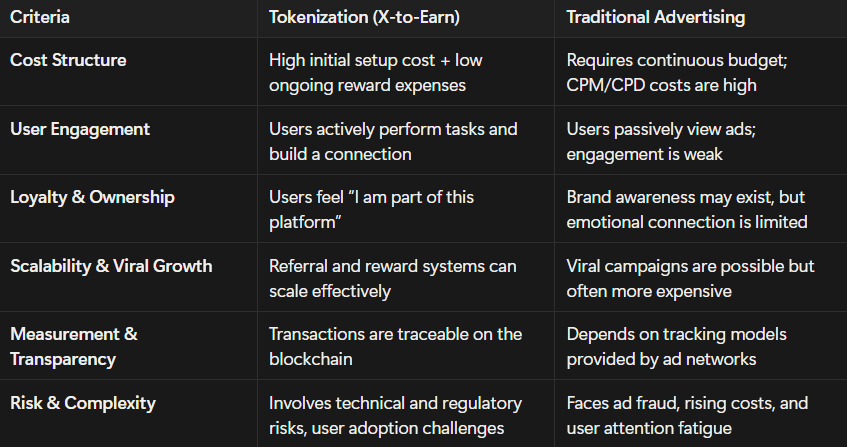
| Criteria | Tokenization (X-to-Earn) | Traditional Advertising |
|---|---|---|
| Cost Structure | High initial setup cost + low ongoing reward expenses | Requires continuous budget; CPM/CPD costs are high |
| User Engagement | Users actively perform tasks and build a connection | Users passively view ads; engagement is weak |
| Loyalty & Ownership | Users feel “I am part of this platform” | Brand awareness may exist, but emotional connection is limited |
| Scalability & Viral Growth | Referral and reward systems can scale effectively | Viral campaigns are possible but often more expensive |
| Measurement & Transparency | Transactions are traceable on the blockchain | Depends on tracking models provided by ad networks |
| Risk & Complexity | Involves technical and regulatory risks, user adoption challenges | Faces ad fraud, rising costs, and user attention fatigue |
As seen in the table above, there are clear differences between the tokenization model and traditional digital advertising. While tokenization requires a higher technical investment in the initial phase, it offers a sustainable and more cost-efficient structure in the long term.
Rather than being passive viewers of ads, users interact with the platform, complete tasks, and earn rewards, which strengthens user loyalty and community spirit.
On the advertising side, issues such as constant budget requirements, increasing click costs, and the distraction of user attention are noteworthy. Furthermore, while the traceability and transparency of transactions in blockchain-based systems strengthen trust, traditional advertising relies more heavily on third-party platforms for this process.
Therefore, the tokenization-based X-to-Earn model has the potential to create a much deeper and longer-term impact in terms of user engagement and brand loyalty.
Cost Comparison: Tokenization vs. Traditional Advertising
Setting up a tokenization infrastructure, i.e., completing processes such as writing smart contracts, interface design, security controls, and regulatory compliance, can cost an average of $100,000 to $300,000 for a medium-sized project (ScienceSoft, 2024).
While this figure may seem high at first glance, it is actually much more advantageous in the long run when compared to digital advertising. This is because brands allocate a budget of $301 to $5,000 per month for digital advertising campaigns, and also pay $0.01–1 per click (WebFX, 2024). Moreover, click costs are increasing every year, advertising algorithms are constantly changing, and brands need to continuously innovate to keep their campaigns effective. This multiplies the total cost over time.
Furthermore, an average of 15% of the expenditure goes to fake clicks or non-converting views (Ebiquity, 2023). On the tokenization side, the situation is completely different. Once the system is set up, the community continues to grow and generate engagement on its own. In other words, with a one-time investment, it can build its own user ecosystem in the long term.
As a result, instead of constantly pouring money into advertising, the tokenization model offers brands a more sustainable, transparent, and self-sustaining solution.
Why Vinu Digital?
Vinu Digital has been providing enterprise-level crypto software solutions since 2017; its portfolio includes end-to-end services such as exchange, asset tokenization, wallet services, AML/compliance, and security-focused consulting — it also clearly communicates that it supports customers during the project discovery phase through case studies and demo request channels (demo request / contact).
This scope allows for the integration of all technical components required for an X-to-Earn project (smart contract development and audit, token distribution mechanisms, wallet integration, KYC/AML flows, scalable backend and operational support, data/analytics monitoring, and fraud prevention measures) with a single provider — thereby shortening the supply chain and reducing project risk. Furthermore, outsourcing the technical and security burden to increase development speed provides a critical advantage for investors.
From a cost perspective, the logic also favors Vinu: independent sources estimate the one-time setup cost for a mid-sized tokenization project to be approximately $100,000–300,000 USD; when properly configured, this can be considered a more sustainable investment compared to recurring advertising budgets over the years.
By comparison, digital ads typically require monthly spending in the range of $301–$5,000, with cost-per-click varying between $0.01–$1 depending on the platform; moreover, a significant portion of ad spend (~15%) goes to waste or non-converting inventory, which undermines ad ROI. [WebFX+1]
Conclusion: The Three-Stage Roadmap
In conclusion, for app owners considering X-to-Earn integration, the analytical and rational roadmap consists of three key stages:
- Discovery and Strategic Design: At this stage, Vinu Digital provides technical discovery support to the client to determine the project's requirements, target user base, and token economy structure. Strategic parameters such as token supply-demand balance, reward mechanisms, and chain selection are configured by an experienced engineering and consulting team. This step is critical to ensuring the project's sustainability and scalability.
- MVP and Behavioral Analytics: During the Proof of Concept (PoC) or Minimum Viable Product (MVP) phase, user behaviors and engagement rates are tested. Vinu Digital implements the application's blockchain integration, wallet connections, smart contract prototypes, and data monitoring infrastructure at this stage. Analyzing users based on Daily Active User (DAU), Retention, Customer Acquisition Cost (CAC), and Lifetime Value (LTV) metrics reveals the project's scaling potential.
- Security, Compliance, and Operational Scaling: Following the testing phase, smart contracts undergo audit processes; KYC/AML compliance layers are integrated, and the system is scaled operationally. Vinu Digital ensures long-term sustainability with security testing, performance optimization, fraud prevention systems, and enterprise-level data analytics solutions.
This three-stage model combines Vinu's end-to-end technical capabilities with the customer's goals to:
- Accelerate the development process,
- Minimize integration risks,
- Increase the return on investment.
Therefore, Vinu Digital is not just a software provider; it positions itself as a long-term technology partner that builds the technical backbone of the project, manages strategic scaling, and transforms the X-to-Earn model into sustainable profit.